
Year Well Spent: Our Custom Oak Dining Table for a San Francisco Home
I was flipping through a retrospective on Dieter Rams — the legendary German designer behind Braun's most iconic products — and I kept returning to one tension in his work: the warmth of natural material sitting next to the precision of cold metal. Not fighting each other.
That idea became the foundation for one of the most considered pieces we've built at PhillBuilt: a custom solid oak dining table with a hand-polished stainless steel base, designed and built for a client right here in San Francisco.
It took about a year from first sketch to final delivery. Every minute was worth it.
The Inspiration: Dieter Rams and the Braun Aesthetic
If you're not familiar with Dieter Rams, you've still lived with his influence. He's the reason Apple products look the way they do. He's the reason "less but better" is a design philosophy and not just a sentence. During his decades at Braun, he created radios, clocks, and home appliances that treated everyday objects as worthy of serious, principled thought.
Rams never hid what something was made of. Wood looked like wood. Metal looked like metal. The craft was in how they met.
That's exactly what I wanted for this table.
Designing for Two Contradictions
Our clients had a deceptively simple ask: a dining table that felt both substantial and light. Solid enough to anchor a room, slim enough to never dominate it. In San Francisco homes — where square footage is precious and sightlines matter — that's not a small ask.
The top presented the first engineering challenge.
A dining table top needs mass. Mass means structural integrity, resistance to cupping and warping over time, and the satisfying weight that signals quality the moment you set a glass down. But a thick top looks heavy. It visually sinks a room.
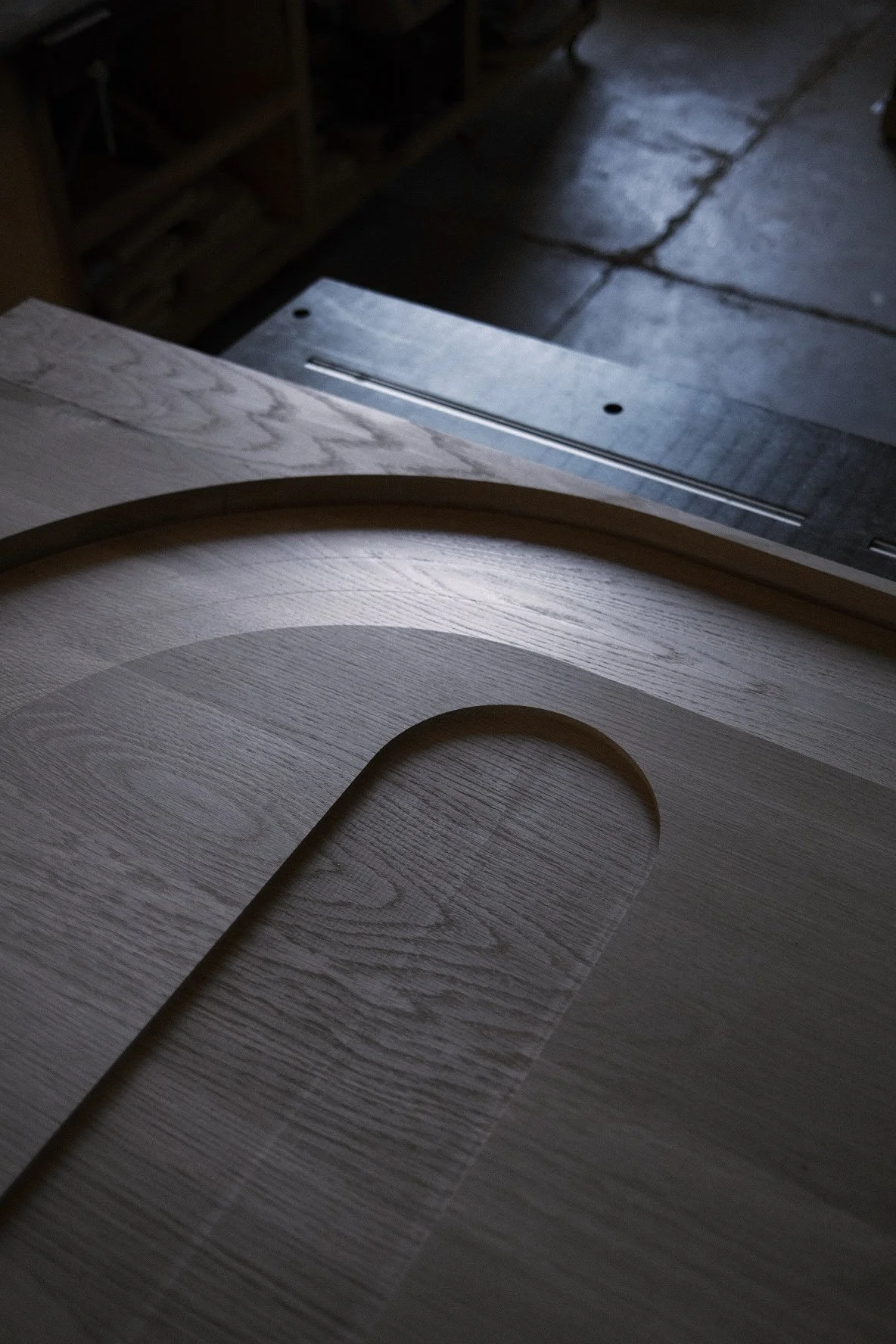
Our solution: 1.75 inches of solid white oak with a 7-inch taper running to the edge. What that means in practice is that from the profile — the view you see sitting at the table, or walking by it — the top reads as just ¾ of an inch thick. Razor-edge slim. The illusion of something almost floating.
The mass is there. The furniture does its job. But the eye never knows it.
Steel Meets Oak: Engineering the Base
The base is where this piece gets its character.
We integrated ¼-inch stainless steel plates directly into the oak base — not bolted on the outside, not wrapped around, but slipped in, almost like they grew there together. The phrase I kept coming back to during construction: these two materials met in the same womb at some point.
The connection had to do more than look seamless, though. It had to account for a basic fact of working with wood that a lot of furniture makers gloss over: wood moves.
Solid oak expands and contracts with seasonal humidity changes. It's not a flaw — it's the nature of the material. But if you fix steel rigidly to oak without accounting for that movement, you're building in a failure point. The wood will crack. The joint will fail. Time will win.
Our answer was oversized slots in the steel plates — engineered gaps that let the oak breathe and shift while the steel holds its position. The table looks like it was made in a single pour. In reality, it's two materials with a carefully negotiated relationship.

The stainless was hand-polished to a finish that sits between mirror and satin — bright enough to catch the light, refined enough not to shout. Up close, you can see the direction of the polish. That's intentional. That's the punk edge.
Elegant, Warm, and Just a Little Punk
If I had to describe the final piece in a few words: elegant and warm, with a touch of punk.
The oak brings the warmth — the grain, the color, the sense that this table has a past and a future. The steel brings the edge — the precision, the hardness, the refusal to apologize for what it is. Together they do something neither could do alone.


What This Project Means for Interior Designers
If you're an interior designer working on a high-end residential project in San Francisco or the Bay Area, here's what a commission like this looks like in practice:
Timeline: Expect 8-10 weeks of production for a fully custom piece of this complexity.
Collaboration: We work directly with you and your client from concept through delivery. Material selections, dimension adjustments, finish variations — all of it is a conversation, not a decision handed down.
Materials: We source premium domestic hardwoods and work with local metal fabricators to keep the supply chain tight and the quality accountable.
Delivery area: We work primarily with clients and design firms across California, Including: San Francisco, Marin, the East Bay, Silicon Valley, and the broader Bay Area.
Commission Your Own Custom Piece
This table now lives in a San Francisco home where it'll be sat around, argued over, celebrated at, and handed down.
If you're an interior designer, architect, or client looking for custom furniture built with this level of care — we'd love to hear from you.
[Get in touch →] https://www.phillbuilt.com/form-submission