
Built for the Building: Crafting the Front Desk of Sacramento's Historic Citizen Hotel
The Citizen is one of Sacramento's most significant buildings — built in 1925, fourteen floors, a landmark address on J Street that's been part of this city's identity for a century. Whatever we built for that lobby wasn't just furniture. It was going to live inside a piece of Sacramento history.
That changes how you work.
The Brief: One-of-a-Kind, Full Stop
The ask was clear from the start: a custom reception desk that belonged in that space. Not something sourced from a hospitality catalog. Not a modified stock piece. Something designed for The Citizen and nowhere else — a piece that could hold its own against the building's bones.
The front desk we built was designed by Indidesign out of Los Angeles, CA.
The materials were decided early: solid walnut for the casework, solid brass for the trim detail, leather for face, and glass integrated into the design. Each one chosen intentionally.
On paper, a straightforward palette. In execution, one of the more complex builds we've taken on.
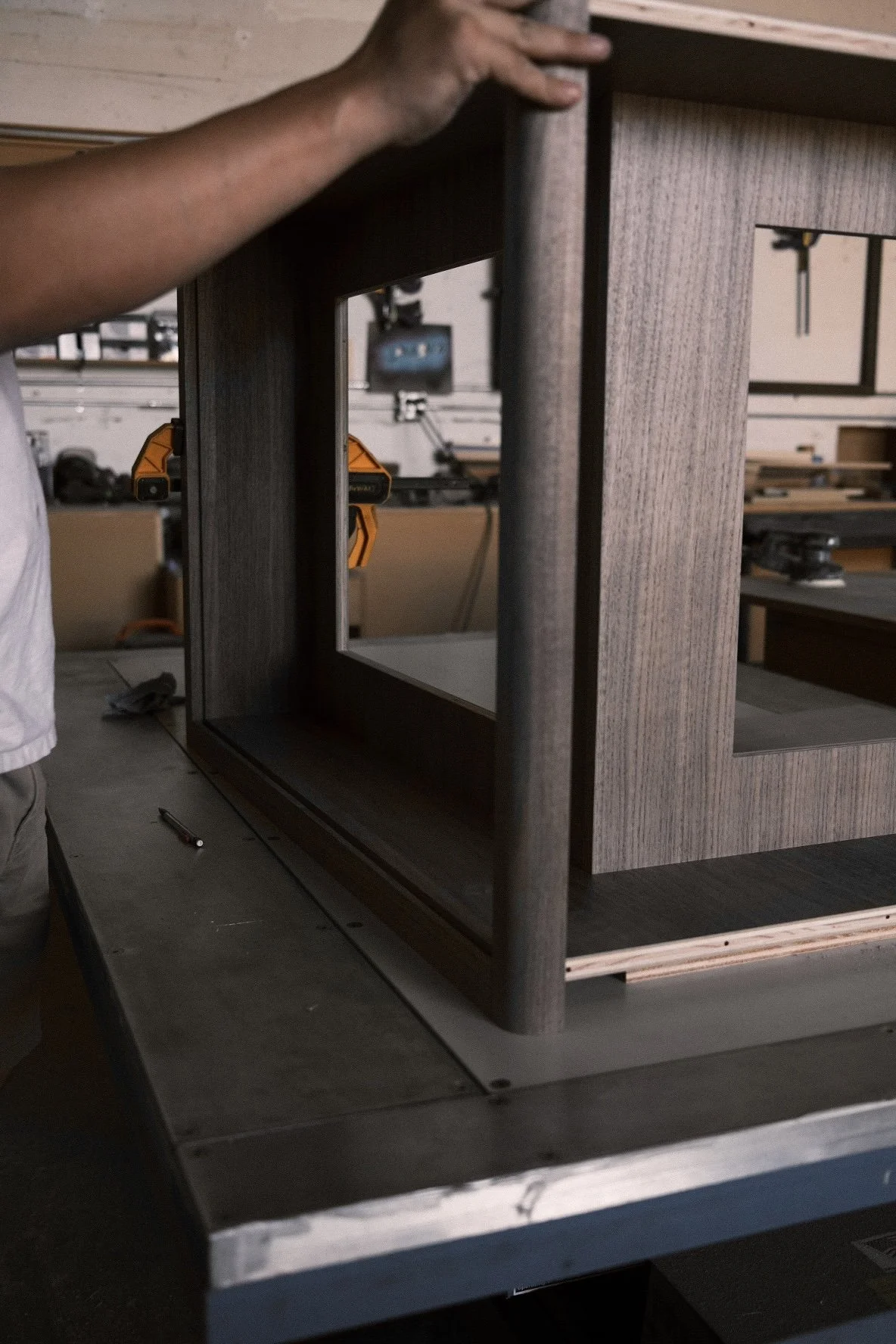
The Problem No One Talks About: Bending Solid Brass
The design called for brass half-round rod to run continuously along the front face of the case — a detail that would frame the entire desk and tie the metalwork into the architecture around it. Clean. Purposeful. The kind of detail that separates a piece built by a maker from a piece built by a manufacturer.
The challenge: the front of the desk isn't flat.
To hug the face of the casework correctly, every run of brass half-round rod had to follow the exact contour of the piece — curves, corners, transitions. Solid brass doesn't bend the way you want it to. It work-hardens. Push it too fast and it cracks. Bend it without a form and it goes irregular. Try to force a tight radius and you'll kink it.
We had to solve this from scratch.
The process we landed on involved building custom bending forms matched to each section of the desk's profile and bending it in stages — checking the fit against the actual casework between each pass. Not against a template. Against the real piece. Because in a historic building with walls that have settled over a hundred years, a template lies to you.
Every section of rod was bent, trial-fit, adjusted, and bent again until it sat flush against the face of the case with no gaps. It was slow, exacting work. The kind of work that doesn't show up in the final photos — until you realize that nothing is rattling, nothing is proud, and the whole thing reads as if it grew that way.
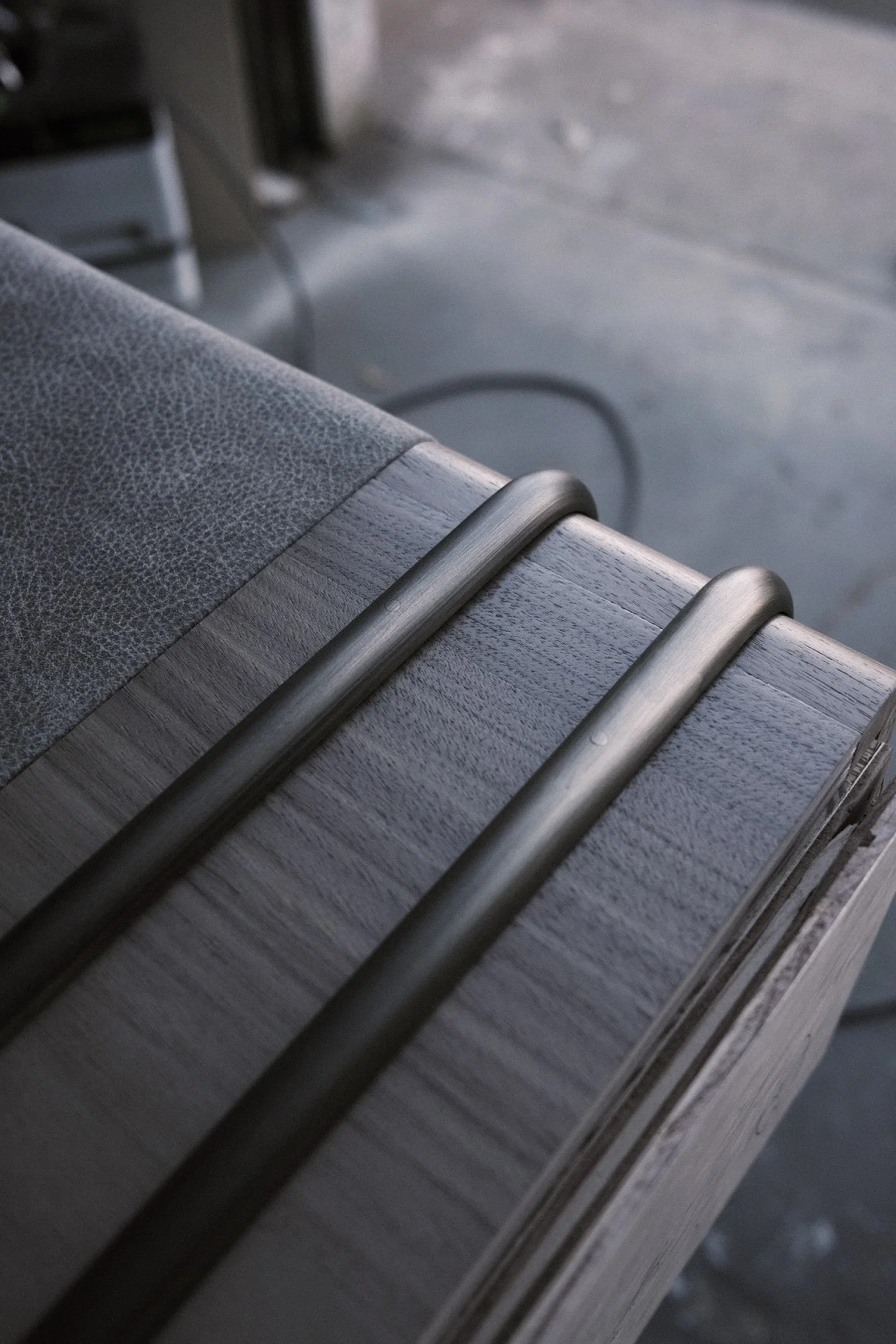
Patina: The Last Conversation the Brass Has With You
Bending the brass was the technical problem. Patina was the aesthetic one.
Raw brass is bright. Almost aggressive. It would have fought with The Citizen's interior rather than supported it. We needed the brass to feel like it had always been there — like the building had absorbed it over decades rather than a crew installed it four weeks ago.
We experimented with multiple patina approaches before landing on the right one. The final treatment gave us a tone that reads warm in incandescent light and deepens toward bronze in shadow. It ages the metal without dulling it. In the lobby of The Citizen, it hits exactly the register it should: refined, historical, earned.
Four Weeks, One Shot
Total build time: four weeks. For a piece of this complexity — multi-material, custom metalwork, historic setting, zero margin for error at install — that's a sprint timeline.
We didn't cut corners to hit it. We ran longer days, stayed tighter on sequencing, and made decisions faster than a larger shop would. The walnut casework was built and finished while the brass work was being bent and patinated in parallel. Glass was templated from the actual finished case, not from drawings. Leather was sourced and installed as the final layer before delivery.
What This Kind of Work Requires
There's a category of hospitality project that sits above standard commercial millwork. It's not defined by budget — it's defined by what the space demands. A century-old hotel lobby demands something different than a tech office breakroom, even if both need a reception desk. The material choices, the detail level, the installation precision — all of it has to be calibrated to the weight of the room.
That calibration is what we do.
We've built custom furniture and millwork for restaurants, cafes, offices, and hotels across California. Each one requires a read of the space before the design begins. The Citizen read as: timeless, substantial, historically aware. Every decision we made flowed from that.
The result is a front desk that will be checking guests into that lobby long after any of us are around to see it. That's the standard we build to.
Working With PhillBuilt on Hospitality Projects
If you're a hotel, restaurant, or hospitality group planning a custom millwork or furniture project — a reception desk, bar top, lobby installation, or branded architectural detail — we'd like to hear about it.
We work directly with ownership groups, interior designers, and project managers. We're equipped for complex material combinations, fast timelines, and the kind of precision that historic or high-design spaces require.
Get in touch at phillbuilt.com or email phill@phillbuilt.com. Tell us the space, the timeline, and what you're trying to build. We'll come back with an honest read on feasibility and a path forward.